

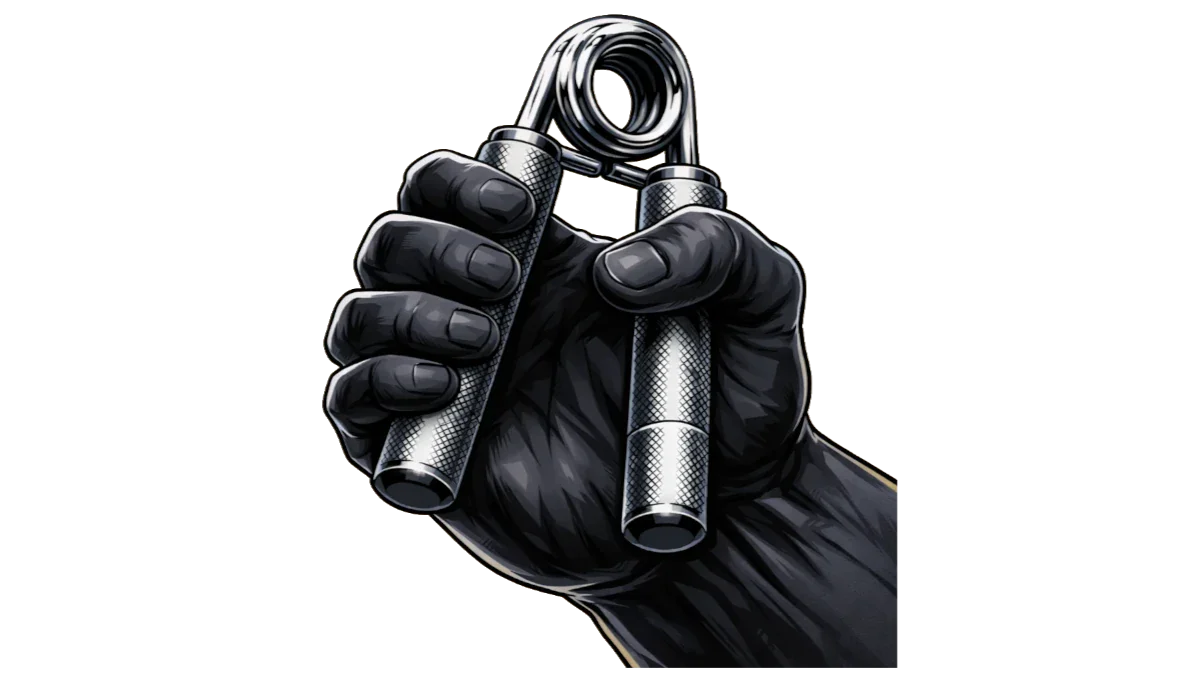
WHY YOUR GRIP DETERMINES YOUR STRENGTH AND HEALTH
Grip strength has become a reliable and monitored indicator for measuring an athlete's fitness level and a person's health in general.
This article explores the various reasons why you need to work on your grip.
DEFINITION AND BIOMECHANICS
Grip (or grip strength) is the force generated by the hand and forearm during an act of grasping .
- Grasping refers to the action of seizing, holding and controlling an object with the hand.
In your daily life, you use it to grab , squeeze , grip and manipulate any object: open a jar, carry shopping bags, turn a handle or suspend your weight above the ground.
Biomechanics
The grip is a more complex gesture than it seems.
It includes not only your hand and fingers, but also your arm , shoulder and shoulder girdle (shoulder blade and its muscles).
When you grasp an object, the force produced by your fingers must be transmitted backwards without loss .
This transmission passes through your forearm and elbow, and is based on the stability of your shoulder and shoulder girdle.
A study has shown that good scapular stability promotes grip endurance.
If the base of your arm is unstable => the shoulder moves excessively => the forearm muscles compensate => you tire more quickly and give up.
That is why:
- Strengthening your scapula increases the duration of your hang from the bar;
- You can lose your grip at the end of a set even though your forearms still have strength;
- Working only your hand/fingers gives limited progress.
In summary
The grip is not limited to the contraction of your hand, but also of your forearm, elbow, shoulder and scapular muscles.
GRIP AND LONGEVITY
Why is a strong grip associated with health?
Grip strength is often mentioned when discussing longevity and is considered a biomarker of health and aging to monitor.
We are talking here about functional longevity : it is not so much the years lived ( biological longevity ), but the years lived in good health and autonomy.
An individual with good grip strength is statistically more likely to retain their functional abilities later in life.
Several studies show that weak wrists are associated with more chronic diseases (diabetes, cardiovascular diseases, stroke, cancers) and longer hospital stays.
An international study of more than 140,000 people, published in Lancet, concluded that decreased grip strength predicts the risk of premature death better than blood pressure .
What is the connection?
Your grip strength is primarily an overall marker of your body's condition .
When your grip weakens, it often reflects:
- Muscle loss
- Sedentary lifestyle
- Decrease in physical capacity
- Less cardiovascular stimulation
- Metabolic degradation
Monitoring your grip strength is therefore interesting because it is simple to measure and it summarizes the overall functional state of your body.
SPORTING INTEREST OF GRIP
"You are never stronger than your weakest link."
In most sports that require arm strength (if not all), your grip is the critical point that will influence your performance.
If you lift a deadlift that is too heavy, for example, it is often your fingers that give out before the muscles in your back or legs.
It's the same when you practice a dead hang; you often still have strength in your forearms to hold on, but your hands give out.
Your grip is the direct link between your body and the object being used, and its importance is therefore fundamental .
Ironically, it's something that can be easily conceived, yet few people actually focus on this aspect in their practice.
The grip to measure your shape
In line with the fundamental importance of grip strength, some coaches incorporate measuring their athlete's grip strength to track their progress:
- If there is an increase in strength , it is a sign that the training is paying off and that the athlete is in good shape.
- If there is a noticeable decrease , this may be a sign of fatigue, overtraining, or specific work that needs to be done.
If you don't have a tool to measure your HRV , another method is to time your grip strength to see if your recovery has been sufficient or not.
The different types of grip
Depending on the sport, working on your grip will be important and the approaches will differ .
- Climbers need maximum grip, working on several aspects
- Wrestlers will likely favor their crush and pinch grip to hold their opponent
- The tennis player, on the other hand, will mainly work on the endurance and dynamics of his grip.
Understanding the different types and fields of application of your grip will help you more easily design which aspects you need to work on in your practice:
This is the most intuitive grip, where the fingers close towards the palm with maximum force . It therefore corresponds to the ability to crush an object by tightly closing the hand.
Areas of application : judo, BJJ, wrestling, bodybuilding, ...
This corresponds to the ability to hold a load against gravity for a certain time, the hand's role being
to prevent the object from slipping.
Areas of application : calisthenics (pull-ups), gymnastics, crossfit, strongman (farmer's walk), ...
The focus here will be on duration rather than strength or performance. The goal is to maintain a grip under prolonged fatigue.
Fields of application : climbing, parkour, hyrox, ...
As its name suggests, it is the ability to hold an object using only your fingers, without the intervention of the palm .
Fields of application : climbing, parkour, calisthenics, judo
This corresponds to the ability to perform a grip during a rotational movement of the arm and/or the object being held.
Fields of application : tennis, golf, baseball, throwing, bushido, etc.
Of course, in most sports you will use the types of grip described here, but some will be predominant over others.
GRIP REINFORCEMENT
Incorporate specific exercises to strengthen your grip
If you practice a sport that requires your grip strength, you are already working on it indirectly through your practice.
However, you can maximize your grip strength with dedicated exercises, to more specifically target certain aspects of your grip.
To squeeze an object tightly, such as crushing a rubber ball or using a gripper (spring-loaded wheel).
This will develop your hand closing strength.
Holding a weight under the effect of gravity, like the farmer's walk (carrying two dumbbells while walking), or hanging from rings or a bar.
It's a good way to work on the stability and endurance of your grip.
Holding an object between the thumb and other fingers without support, for example lifting a disc weight by the edge .
You will very rarely see someone use this exercise, which can nevertheless be very useful for improving their grip.
This type of exercise is actually more widespread.
Holding a heavy object and performing rotations , such as when practicing kettlebell halo exercises, or exercises with a heavy jump rope or hammer.
You can incorporate these different types of exercises to complement your sessions in order to have a complete workout on the movement you are trying to perform.
Scapular strengthening
As mentioned at the beginning of the article, working on your grip is not limited to working on your hand but also includes your forearms, shoulders and shoulder girdle.
Incorporate exercises like scapular push-ups , scapular pull-ups , planks with straight arms , ... to strengthen your base stability and get a complete grip workout.
A balanced program will combine all these methods, in addition to your standard training, for bioptimal progression.
FAQ
Frequently asked questions
The most accurate method remains the grip strength dynamometer , which measures the maximum force exerted during a complete hand closure.
It allows us to obtain a numerical value, comparable over time and between individuals, provided that a constant protocol is followed (standing position, arms along the body or at 90°, same hand, same instruction).
In the absence of a dynamometer, you can perform functional tests : maximum time spent hanging from a bar (dead hang), distance or time maintained on farmer's walks, or ability to close a clamp of given resistance.
Yes.
The muscles in the hands and forearms are small but used very frequently, even in everyday movements. Overtraining them can cause tendon fatigue, cramps, or decreased performance in other movements.
A strength disparity between the dominant and non-dominant hand is common.
As long as it remains moderate, it's not a problem. Beyond that, the imbalance can limit your progress or increase the risk of injury.
To remedy this, it is necessary to include unilateral exercises (hand-by-hand work) and sometimes structure training so that the weaker hand gradually catches up with the dominant one.
Several signs should alert you: persistent pain in the tendons of the fingers or wrist, a burning sensation that does not disappear after warming up, a sudden decrease in the ability to hold loads that were usual.
In this case, reduce the intensity, incorporate active rest, and, if necessary, consult a professional to avoid problems such as tendinopathy.