

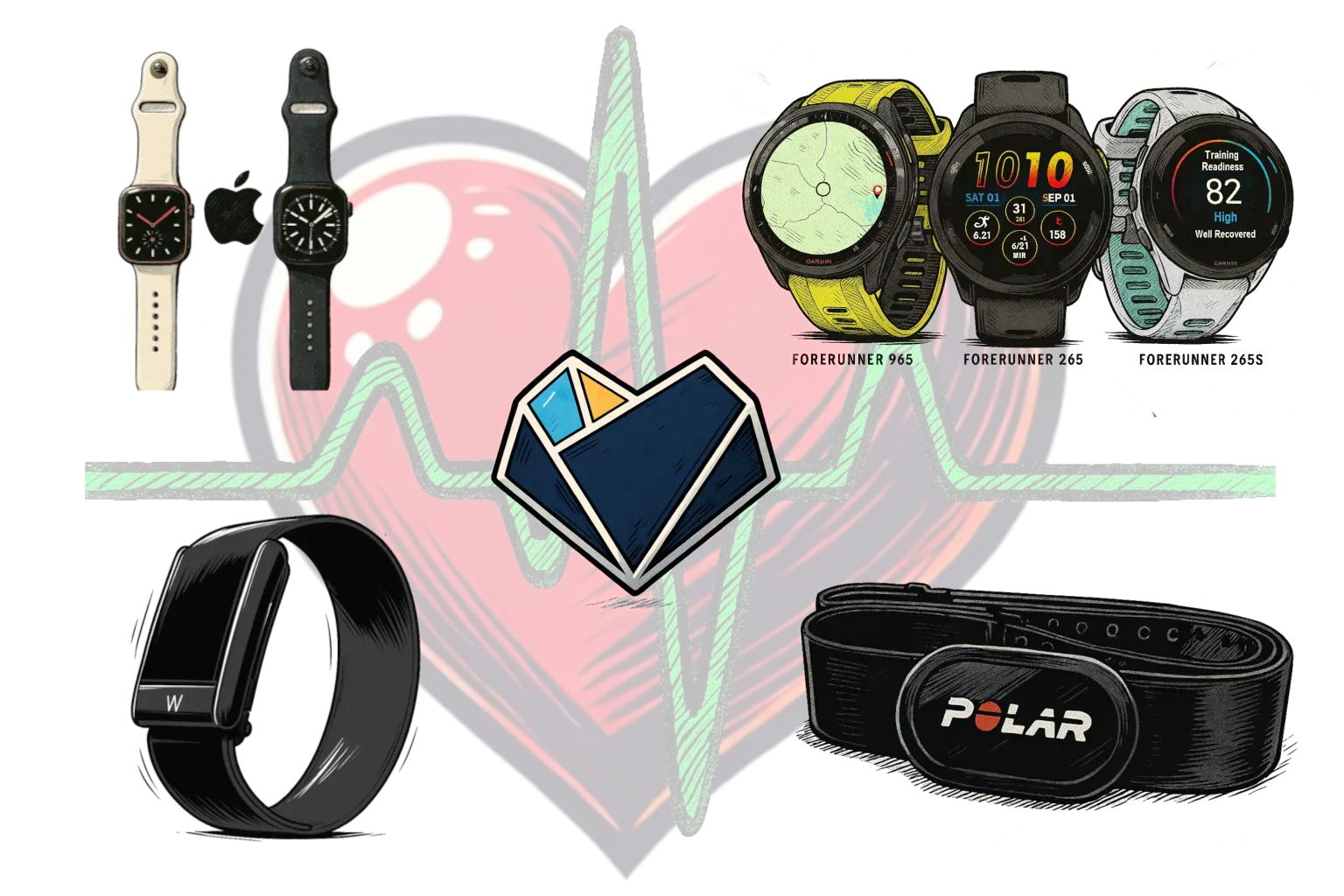
TOOLS TO MEASURE YOUR HRV
Stringing together workouts forces you to optimize your recovery
You've probably set up a routine for this purpose, and you're trying to find out if it's really effective?
In this case, your HRV is the number one indicator to monitor , and here are the different tools that will help you with this goal.
MEASURING SENSORS
To briefly address the technical aspect, there are two types of sensors used to evaluate HRV: the ECG sensor and the PPG sensor.
A sensor that directly measures the heart's electrical activity. It is used exclusively for morning measurements (or for other use cases).
It is considered more reliable because it is less prone to erroneous data (simpler measurement conditions).
This is what we find in heart rate monitors like the Polar H10 .
Also called an optical sensor , it measures variations in blood flow under the skin using a light sensor. It is used for morning and nighttime measurements .
This is what we find in watches, trackers and in the cameras of some phones.
Considered less reliable because it is easier to perform the measurement incorrectly and obtain skewed data.
Even though ECG has a better reputation, data obtained from PPG sensors remains reliable if you perform the measurement correctly.
How to measure your HRV effectively
MORNING VS NIGHT MEASUREMENT
There are now two ways to monitor your HRV: via morning measurement and via nighttime measurement .
It is important to clearly distinguish between the two approaches because the interpretation will be different:
Morning measurement is a manual approach that you perform yourself in the morning, directly upon waking.
It allows you to know precisely whether your body has recovered sufficiently for the day ahead or whether you should prioritize rest.
For reliable data, it is important to apply it under the right conditions .
More information here
Nighttime measurement is an automated approach, integrated into most health trackers (Apple Watch, Whoop, Oura, Garmin, ...), which analyzes your HRV to assess the quality of your recovery during the night.
It provides a reliable indication of your past recovery . This is a different approach than the morning measurement, which tells you your current state.
That's why the two measurements tend to give different results . You may have recovered well overnight, but perhaps not enough.
If you are an athlete and are looking for a precise indicator of your condition for the day, morning measurement is the most suitable.
If you are monitoring your recovery and adaptation capacity in general, the nighttime measurement works very well.
Namely
If you don't have a fixed routine for your workouts (sometimes in the morning, sometimes at the end of the day) or your evening meals (dinner at different times), morning measurement remains the most appropriate for reliable data.
COMPARATIVE
We can now explore the tools available to track your HRV, optimize your recovery and better organize your sessions.
Among the most popular, four main categories stand out: heart rate monitors, specialized applications, smartwatches, and health trackers.
HEART BELTS
Polar H10
The Polar H10 is the reference, often cited when talking about measuring HRV.
The interval data collected is considered very reliable, and it is often used in sports research.
The H7 and H9 models are also highly regarded.
- ECG measurement, recognized accuracy for HRV.
- Compatible with specialized applications via Bluetooth and ANT+
- Chest straps need to be damp to give a good signal, so remember to wet yourself slightly before taking the shot.
- The mere fact of having to put on your belt upon waking up (in addition to wetting it) can be a deterrent.

Garmin HRM-PRO Plus
Garmin heart rate monitors (HRM-PRO, PRO Plus, or other recent models) are also of very good quality.
They are recognized for measuring heart rate data and offer additional metrics (running dynamics, power data, among others) compared to Polar.
Something to consider if you plan to use it for something other than your VFC.
- ECG measurement, data considered reliable
- Garmin multi-device compatibility
- Compatible with specialized applications via Bluetooth and ANT+
- Chest straps need to be damp to give a good signal, so remember to wet yourself slightly before taking the shot.
- The mere fact of having to put on your belt upon waking up (in addition to wetting it) can be a deterrent.
- The price may be too high if you're only looking to control your HRV

SPECIALIZED APPLICATIONS
Elite HRV
It's one of the most popular apps for HRV (Heart Rate Variability) tracking. Its free version offers a lot of information, including data on your current trend.
It offers a "Morning Readiness" score, a recovery indicator, as well as guided breathing tools and other exercises to improve your heart rate.
- The free version is a good tool for obtaining basic data on your HRV.
- Allows you to measure your HRV with the phone's camera (optical measurement - PPG).
- Compatible with most connected devices
- The application is easy to use
- A monthly subscription of $8 provides comprehensive data on your HRV (impacting factors, demographic comparisons, etc.)
- Application available in English only

HRV4Training
This is surely the most rigorous application in terms of VFC.
It offers you a daily subjective questionnaire (sleep, stress, etc.) in addition to providing objective data, integrating everything into the analysis of your recovery.
It allows you to reliably measure your HRV using your phone's camera (PPG) and is compatible with all kinds of connected devices.
- Complete data on your HRV and the factors that impact it.
- Allows you to measure your HRV with the phone's camera (optical measurement - PPG).
- Compatible with most connected devices
- Affordable price (€10), one-time purchase (no subscription)
- No free access like with other apps.
- The app is not very user-friendly and is available in English and Spanish.
- Suitable for a more advanced audience.

SMARTWATCHES
Apple Watch
The Apple Watch records your HRV via nighttime measurement thanks to its built-in optical sensor. It also allows you to take morning measurements using the Mindfulness app.
The measurements can then be viewed in the Health app.
However, it is not recommended for use in nighttime measurements because it only collects certain segments of your sleep , which limits the reliability of the data.
- Possibility of performing morning measurements (reliable)
- Apple multi-device compatibility
- Compatible with specialized applications via the Health app
- Unreliable nighttime measurements
- For a clear rendering of your HRV, it is recommended to use a third-party application (the Health app is limited in this respect).

Garmin
Garmin watches perform nighttime measurements and their data is considered reliable.
They provide access to your HRV, your 7-day average, and your current status indicating whether you are in a good recovery phase or not.
- Garmin multi-device compatibility
- The app displays relevant data about your HRV and current fitness level
- No morning measurements possible
- No access to precise data (RR and rMSSD) that cannot be exported for third-party applications.

Coros
Some Coros watches, such as the Apex Pro 2 , allow ECG measurements in addition to optical measurements, which is not the case with other connected devices.
However, the Coros application only provides a recovery index from 1 to 100, and not the average of intervals, which can be limiting if you are looking for precise data and forces you to use a third-party application.
- Ability to perform rapid ECG measurements
- Possibility of monitoring one's nocturnal and morning HRV
- The recovery index of 1 to 100 is useful if you're looking for simplified data.
- You'll need to rely on third-party applications if you want accurate HRV data.
- The data is difficult to export, so third-party applications need to be integrated with Coros.

HEALTH TRACKER
Whoop Band
Whoop bracelets automatically measure your HRV during the night, but it is also possible to take manual measurements upon waking using compatible third-party applications.
Heart data is easily exportable, allowing you to get more detailed tracking if you analyze it with a specialized application.
- Possible nighttime and morning measures
- The app displays relevant data about your HRV and current fitness level
- Good compatibility with other applications for more detailed tracking
- Morning measurements are not available directly on the native app
- The optical sensor is known to be less precise in terms of net value, but the variations and trends are considered reliable.

Oura Ring
These rings are well known for sleep data but also for nocturnal HRV measurements.
The data can be easily exported and used by other applications, but manual measurements cannot be taken.
- Nighttime data considered to be very reliable
- Provides a clear visualization of HRV within the application: nightly average, 2-week trend, and correlation with sleep
- Good compatibility with other applications for more detailed tracking
- Measurement only at night; no possibility of manual morning measurement.

FAQ
Frequently asked questions
Heart rate variability (HRV) has significant natural variability , even in the absence of major stress. Factors such as mild dehydration, a change in temperature, a heavier meal, or even the phase of your circadian rhythm can affect your score. It's not the single value that matters, but the trend over several days.
Learn more
PPG analyzes light: it measures variations in blood flow under the skin. This method is sensitive to micromovements, the quality of contact with the skin, temperature, and even pigmentation.
The ECG, on the other hand, measures the electrical activity of the heart directly; it is therefore less prone to errors.
Daily measurement is ideal. Below that frequency, interpretation becomes difficult because you lose the continuity needed to identify trends. Above that frequency (several times a day), it rarely provides an additional benefit except in specific cases (advanced research, medical monitoring).
It depends on your goal. The nighttime measurement reflects the overall state of recovery very well, but it doesn't always capture your physiological readiness for the current day.
If you want to adapt your training to your daily routine, morning measurements are more relevant. For overall monitoring, nighttime measurements are perfectly sufficient.
They can be if the conditions are strictly controlled : fixed position, stable breathing, stationary phone, good lighting.
However, they remain less precise than an ECG sensor.
There is no universal value considered “good”, as HRV varies enormously from person to person.
If your HRV is regularly higher than your usual average, this often indicates good recovery.
If it remains consistently below this level, it more likely indicates accumulated stress or insufficient recovery.