

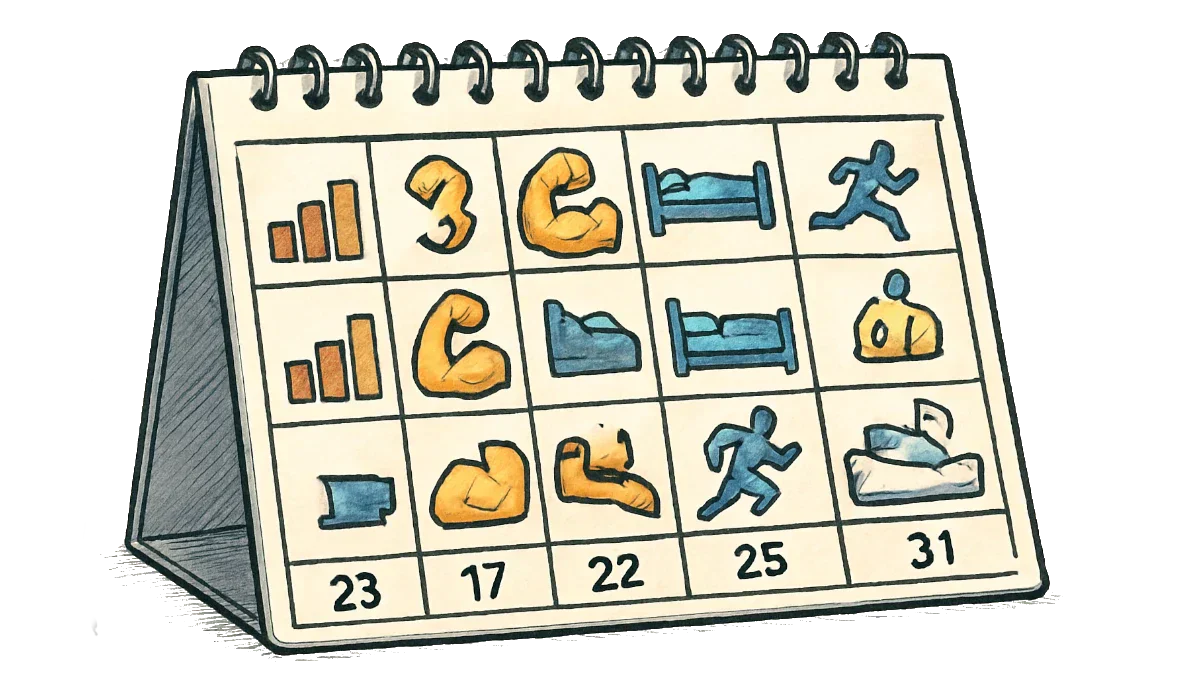
STRUCTURE YOUR SESSIONS THROUGH PERIODIZATION
"He who does not know the port he wishes to reach will never find a favorable wind." - Seneca
It's easy to get lost when you're moving forward without a clear direction. Without a goal or a plan, you often end up taking the wrong path... or the longest one .
This applies in life as well as in your sporting practice.
The purpose of periodization is to address this issue: structuring your training around a specific objective in order to move forward and progress in the right direction .
WHAT IS PERIODIZATION?
Definition
Periodization is defined by the planning of training sessions in different periods or cycles .
This is the overall period over which your training plan will be established. If your deadline is 6 months, this will therefore correspond to your macrocycle.
It is a segment of the macrocycle which generally corresponds to a period (several weeks/months) dedicated to a targeted quality or variable (strength, endurance, load, deload, ...).
This corresponds to the different typical sessions/weeks within your mesocycle where you concretely establish the exercises , intensity and volume to be provided.
We therefore alternate training variables (volume, intensity, frequency, types of exercises) in a programmed manner over a defined period in order to provoke different adaptations .

The goal is to optimize physical performance without leading to overtraining by varying the types of sessions.
In summary
Instead of training the same way all year, you alternate between distinct phases, each with a specific focus.
Origins
The concept of periodization was greatly influenced by physiologist Lev Matveyev and coach Tudor Bompa , who are considered pioneers of this approach.
The initial objective, proposed by Matveyev, was to organize the preparation of athletes for very specific competitions (Olympic Games, international championships, etc.) by planning their training cycles over a year.

The concept was later refined by Bompa, who introduced the notions of double and triple periodization for sports requiring multiple performance peaks throughout the year. Over time, other coaches and researchers have further developed periodization to meet the evolving demands of sport.
WHY PERIODIZE YOUR SESSIONS
Stimulating adaptation
Living beings are constantly adapting to their environment.
Throughout history, changes in climate, resources, and lifestyles have shaped human populations with diverse characteristics across different regions of the world. Each new context has gradually forced their bodies to evolve .

The approach here is different, but the logic is the same: endlessly repeating a linear training routine breaks this progression . Therefore, by alternating training phases, you stimulate adaptation, avoid stagnation, and prevent overtraining.
Studies have shown that periodized programs generally induce better long-term strength and power gains than non-periodized programs ( source ).
Avoid injuries
By alternating periods of intense training with lighter periods dedicated to recovery or another type of work, you dissipate accumulated fatigue while continuing to progress.
This allows you to benefit from genuine active recovery .
Example
In bodybuilding, alternating between muscle-building phases (high volume, moderate loads) and strength-building phases (reduced volume, heavy loads) allows you to work the body differently and avoid continuously overworking the same systems .
Conversely, maintaining a significant and repetitive effort without a break leads to chronic fatigue and increases your risk of injury.
Targeting performance peaks
Top athletes do not seek to be at their peak fitness all year round: they target key competitions .
This principle also applies to an amateur athlete preparing for a marathon or a powerlifter aiming for a personal record.
A well-designed periodization allows the progression and sharpening phases to be organized in such a way as to reach peak performance at the desired time .
Example
A long-distance runner could structure their year into a winter phase of fundamental endurance, followed by a block of VMA (maximum aerobic speed) work in the spring, then a taper just before their autumn marathon.
In summary
- Periodization brings variation and structure to training, resulting in better adaptations and fewer injuries than monotonous training.
- It's not just for strength or hypertrophy: it applies to all physical qualities. It can also be used to improve mobility or flexibility by alternating phases of intensive flexibility work with maintenance phases, for example.
THE DIFFERENT TYPES OF PERIODIZATION
Several periodization models have developed over time, each with its own particularities.
The main types that are most commonly found are:
- Linear (or traditional) periodization
- Wave (or non-linear) periodization
- Periodization by blocks
- Conjugate (or simultaneous) periodization .
Linear periodization
Linear, or traditional, periodization is the original model formulated by Matveyev and Bompa.
The principle is simple : you gradually increase the training load, in a "linear" way, over the course of cycles.
In practice, you gradually increase the intensity (weight, speed, resistance, ...) while decreasing the volume (number of repetitions, distance, duration of the session, ...).
The classic approach is therefore to start with high volume and moderate intensity sessions and end with moderate volume but higher intensity sessions as you get closer to the target date.
Imagine a 12-week weight training program aimed at improving your maximum squat strength.
In linear periodization, you could plan:
- Volume/hypertrophy phase : 4 weeks of 4 sets of 10 repetitions at a moderate load
- Strength transition phase : 4 weeks of 4 sets of 6 repetitions with a heavier load.
- Maximum strength phase : 3 weeks of 5×3 repetitions with very heavy load + 1 week of peak with attempts close to 1RM and rest before testing the record.
Wave periodization
Undulatory (or non-linear) periodization is characterized by more frequent variations in intensity and volume within cycles.
Instead of continuously increasing the load week after week, you regularly alternate heavy and light workouts, or high and low volume phases, forming a kind of wave .
- Daily wave periodization : you vary the phases of intensity and volume during the same week.
- Weekly wave-based periodization : you vary the intensity and volume phases from one week to the next.
Let's take a weekly wave pattern:
- If a linear plan had increased the intensity from 70% to 75% then 80% then 85% over four weeks.
- A wave-like plan could be 70% in week 1, 80% in week 2, drop back down to 75% in week 3, then rise again to 85% in week 4.
You train 3 times a week to improve your 100m sprint using a daily undulating training pattern:
- Monday - Explosiveness : short accelerations and starts (push work, 10–20m sprints, starting technique)
- Wednesday - Speed : maximum speed sprint (30-50m)
- Friday - Endurance : sprint under fatigue (150-200m repeated, short rest time).
Periodization by blocks
Block periodization adopts a more sequential approach.
You break down the training phases into blocks of several weeks during which you focus on developing a small number of qualities, while maintaining the rest at a maintenance level.
This concept, initiated by Vladimir Issurin, is based on planning where each block has a targeted objective and a logical sequence .
The goal is to create a segmented and cumulative progression logic to reach your performance peak at the end of the cycle.
Issurin speaks of three types of successive blocks in a macrocycle: accumulation, transmutation, realization.
- The accumulation block aims to develop the general basics (hypertrophy, aerobic capacity, endurance, ...);
- The transmutation block focuses on qualities more specific to the targeted performance (maximum strength, explosiveness, specific technique) by transforming the gains of the previous block into something more concrete;
- The execution phase corresponds to the final preparation for competition, where you seek to express the work done while recovering from fatigue (sharpening, high-intensity testing, technical refinement).
However, it remains an open structure and the blocks can take different forms depending on the sport and the context presented.
Let's take the example where you're training for a 100m sprint. You can organize your sessions like this:
- An 8-week accumulation block to work on the basics: leg strength, speed endurance, starting technique, ...
- A 6-week transmutation block focused on specific speed: short sprints, plyometrics, explosiveness, ...
- 3-week training block to prepare for the race: tapering, light training volume, maximum sprint starts, recovery.
Conjugate periodization
Unlike block periodization where you work on different qualities separately, combined periodization aims to work them in parallel .
The goal is to never completely neglect any quality , maintaining them all at a certain level at all times, while gradually progressing across the board.
In practice, in the same week you may have to work on maximum strength, explosiveness, hypertrophy and endurance, through separate sessions.
With this approach, you will also regularly change the exercises or methods used to continually stimulate adaptations .
The Westside method perfectly illustrates combined periodization. Each week, a Westside powerlifter typically performs:
- A maximum strength workout for the lower body
- A maximum strength workout for the upper body
- A dynamic (explosive) session for the lower body
- A dynamic session for the upper body
Summary table
SETTING UP YOUR SESSIONS
You now know what periodization is and the different approaches to consider.
So it's time to establish your own routine to optimize your performance !
The first step in organizing your sessions is to clearly define " what is my end goal? " and " how soon do I need to achieve it? ".
Examples :
- Gain 5 kg of muscle mass in 6 months
- Improve my 10k time by the September race
- Achieve the splits in 3 months.
Once you have the objective in mind, what constraints do you have to deal with?
It's important to identify them in order to create a realistic, structured plan that easily fits into your lifestyle.
Examples :
- How many sessions per week can I do?
- What equipment/infrastructure do I have available?
- Do I have any personal, professional, or travel obligations that might interfere?
This step is unique to each individual and will depend greatly on your context, your objective, and the type of physical activity you practice.
You can also combine several periodization models . You can, for example, integrate a linear periodization within each block of a block-based periodization.
Your overall structure is identified, you can now plan your progression over time in an orderly fashion by defining your cycles in this order: macro → meso → micro.
Example :
- Macrocycle : 3 months (your final deadline).
- Mesocycles : 4-week blocks oriented towards a specific dominant (hypertrophy → strength → mobility).
- Microcycles : the typical week that defines the distribution of your sessions, the volume, the intensity, ...
Plan weeks of active recovery or deloading.
Good planning includes phases to absorb gains , not just to accumulate fatigue.
Examples :
- One week of active recovery between each block (periodization by blocks).
- 4 days of total recovery as soon as fatigue markers rise too high (HRV, declining performance, ...).
- One week of deload at the end of each mesocycle (linear or undulating periodization).
Self-regulation
Even if you make a well-thought-out plan, it's difficult to anticipate your actual form when the time comes.
The principle of self-regulation is to adapt the volume or content of a session according to your feelings and your state of fitness , rather than blindly following the plan set on paper.
⚠️ Warning ⚠️
Self-regulation doesn't mean "improvising and going by feel." If you tend to be lax, it can become an excuse to do less . The goal remains to follow the basic plan as best as possible.
VFC and RPE
You have two different ways to attest to your current form: the objective approach and the subjective approach.
Heart Rate Variability (HRV) is the most reliable indicator for assessing your performance readiness. Learn more
This approach allows for an unbiased assessment of your fitness level.
You can therefore adapt your sessions according to your current HRV:
- Your HRV is low : opt for a light session that day to prioritize recovery.
- Your HRV is high : today is the day to exert maximum effort.
The Rating of Perceived Exertion (RPE) is a personal estimate, ranging from 1 to 10, of the effort exerted during a session or exercise.
Examples:
- You couldn't finish your session because it was too intense and your body couldn't keep up, the RPE would be 10/10.
- You have finished your session and you feel that you still have energy to do another 30 minutes: RPE of 6/10.
You can therefore adapt the next session according to how you feel to best manage your current fitness level.
These two tools can help you adapt your sessions and aim to optimize your energy level as much as possible.
The ideal approach is to combine both approaches: you limit personal biases while maintaining a certain distance from real data , which does not always reflect your reality.
CONCLUSION
Periodization is simply structuring your sessions in a logical and thoughtful way, to progress towards the goal you have set for yourself.
It is not a fixed framework that you must submit to at all costs, but rather a compass that allows you to have a clear direction to move towards, while more easily tracking your progress.
FAQ
Yes. Even without an official deadline, any goal (muscle gain, improved cardio, strength, etc.) benefits from being planned. Periodization helps you progress methodically, avoid plateaus, and better manage fatigue in the long run.
The choice depends on your level, your objective, and your deadline.
Linear periodization is simple and effective for a single medium-term goal. Wave or conjugate periodization is suitable if you have several qualities to develop or frequent constraints. Block periodization is relevant for complex or competitive goals where each quality deserves a dedicated block.
A macrocycle corresponds to the overall period (e.g., 3-12 months) leading up to your goal.
A mesocycle is a segment of this macrocycle (often 4-8 weeks) targeting a specific quality (volume, strength, speed).
A microcycle corresponds to the typical week or session, in which the concrete variables (volume, intensity, frequency) are detailed.
Try incorporating them at the end of each mesocycle , with a reduction in volume or intensity (for example, 30-50% of your workload or shorter durations). The goal is to eliminate accumulated fatigue to start fresh.
No. Even though the principles are similar, different physical qualities require different training. For example, for maximum strength you decrease volume and increase intensity, while for hypertrophy you prioritize high volume with moderate intensity. Appropriate periodization must take into account the target objective.
By integrating self-regulation , regularly assessing your condition (via HRV , RPE ) and planning for room for maneuver (rest days, shorter blocks, adjustments).