

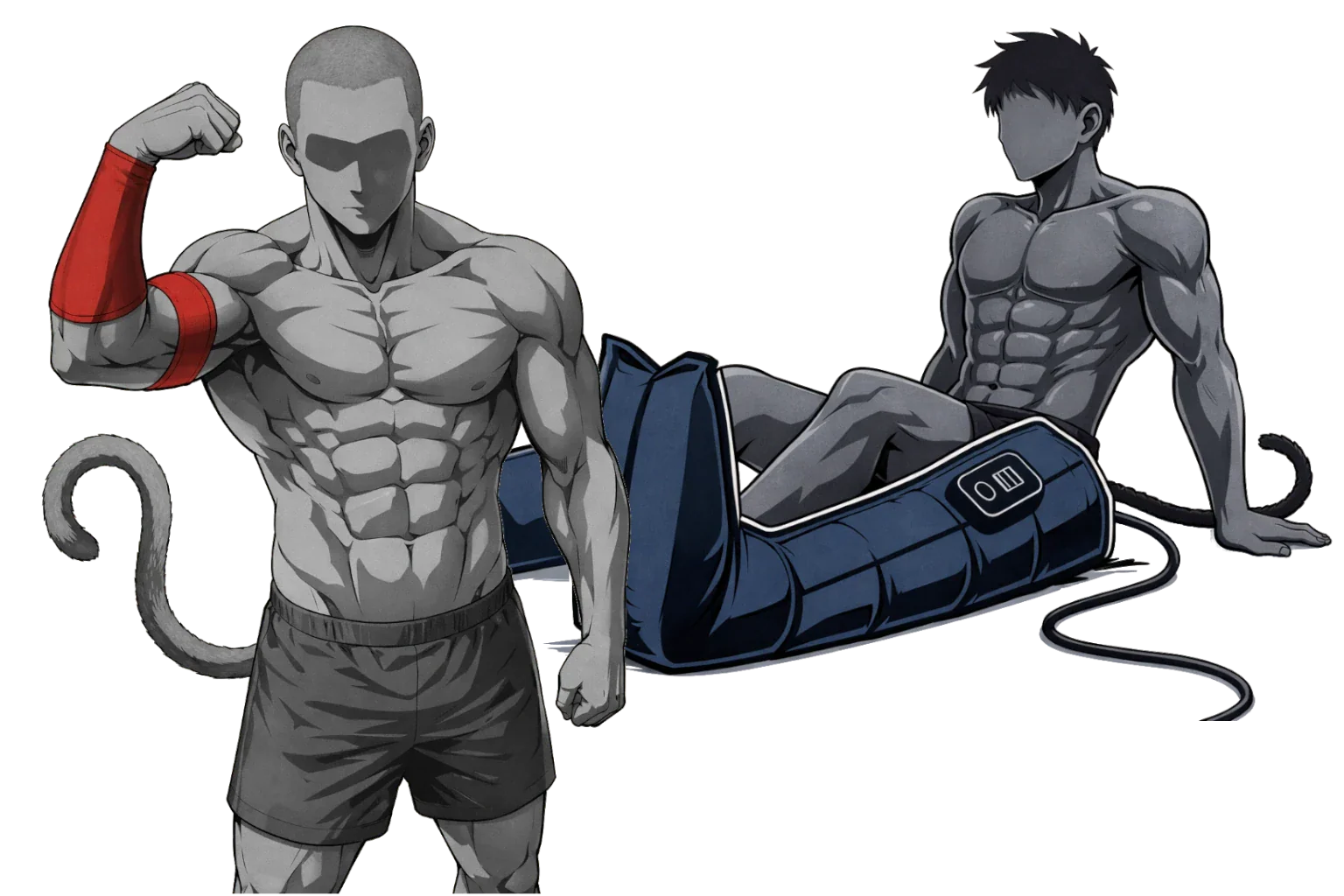
MUSCLE COMPRESSION AND RECOVERY
Compression is fundamentally a medical tool. It is used to limit edema, treat venous disorders, or prevent thrombosis.
And when you think about it, it makes sense that this principle is adopted in the world of sports. When you train, you also create conditions that slow down your blood circulation .
So why not use a method that has already proven itself?
ROLE AND BENEFITS OF COMPRESSION
The basic principle is to apply pressure to a part of your body to help blood flow back towards the heart.
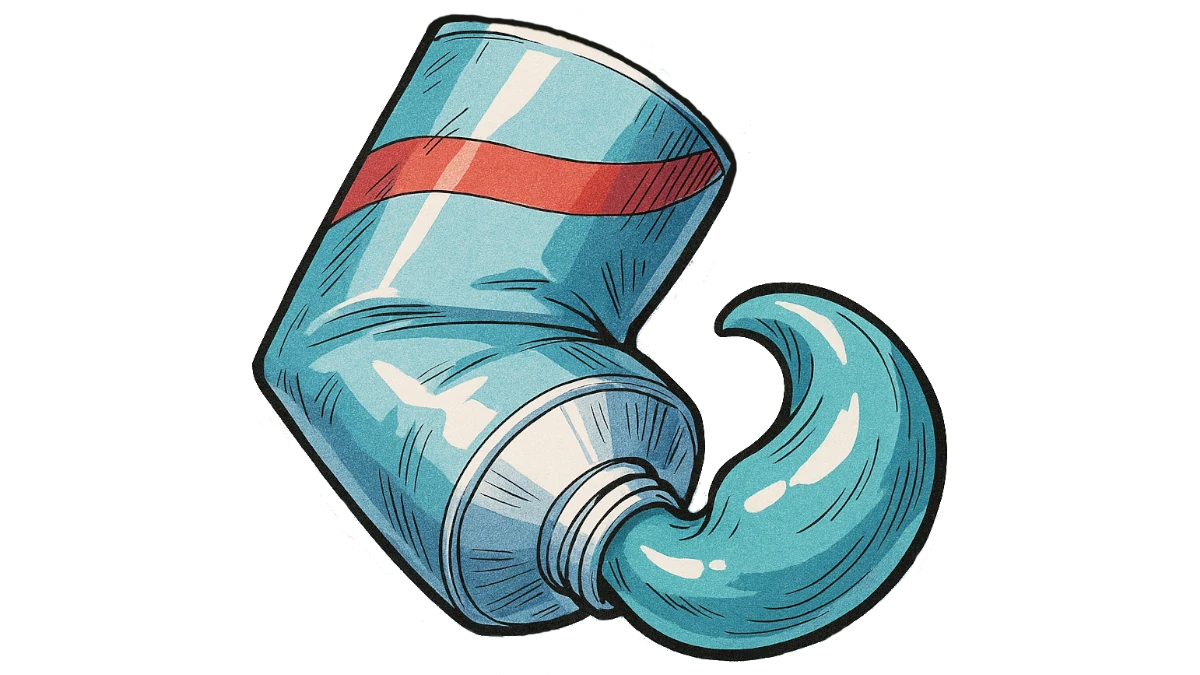
If you had to picture it simply: it's a bit like squeezing the bottom of a tube of toothpaste to get the paste to come up.
The theoretical approach
This applied pressure produces several effects that are often highlighted when discussing compression:
The pressure facilitates the return of blood to the heart , which limits stagnation in your legs or arms (depending on the part of the body compressed) and can reduce the feeling of heaviness after exertion.
By keeping tissues more stable during exercise, the effects of compression could limit microtrauma related to repeated impacts (especially in running or jumping).
By reducing fluid buildup around the muscles, compression could limit swelling and offer a feeling of lighter legs.
However, Although compression does produce these effects, studies have not clearly demonstrated that it actually accelerates recovery at the level of biological markers, and results vary between individuals.
The subjective effect
However, where it becomes interesting is in terms of feelings .
The athletes studied report that they feel better, recover faster, have less muscle soreness and a real overall comfort.
The placebo effect may therefore play a role, but it shouldn't be ignored. Because ultimately, feeling better is a factor in recovery .
And that's surely why many athletes choose to incorporate compression into their routine, more than pure mechanics.
PASSIVE COMPRESSION
Simply put, passive compression is any garment that applies constant pressure to your muscles without you having to think about it .
This includes compression socks or stockings, arm or leg sleeves, and compression shorts, tights and tops.

These are practical tools that you can put on after or during your workout, during a long journey, or even to sleep.
How does it work?
These clothes apply continuous pressure to your skin, often in a graduated manner : stronger at the ankle or wrist, then decreasing towards the top.
This helps blood flow back up, drains accumulated waste from your muscles, limits swelling, and reduces vibrations.
What pressure should I use?
For it to be effective, aim for a pressure between 20 and 30 mmHg . This corresponds to class 2 compression in medicine.
Below 15 mmHg , the effect is often too light to make a difference.
Above 30 mmHg , it can become unpleasant, or even bothersome over time.
Ideally, you should have graduated compression that respects the natural direction of circulation.
Compression is measured in mmHg . This value, often indicated on the label, gives you an idea of the pressure exerted by the garment or device you are using.
When to use it?
Especially useful if you run or practice a sport with repeated impacts : it helps to stabilize your muscles, limit vibrations and delay fatigue.
Apply directly after your session, and keep on for between 2 and 24 hours, depending on how you feel.
Some athletes wear them during long journeys, at night, …
In summary
Passive compression is an accessible tool, simple to use and appreciated by the majority of athletes.
Its effects remain modest but can make a difference to comfort, aches and pains and the feeling of recovery.
ACTIVE COMPRESSION
Active compression, also called pressotherapy , uses devices that inflate and deflate air compartments around your legs or arms.
The idea? To apply rhythmic pressure, in cycles, like a physiotherapist performing manual lymphatic drainage .

You will often see it in the form of large inflatable boots or air sleeves.
Functioning
The principle is the same as passive compression but in a more intense and targeted way.
Sequential inflation mimics what your body does naturally when you walk or get a massage: it pushes fluids, releases, then starts again.
This is called intermittent pneumatic compression (IPC): for example, you inflate for 30 seconds, release for 30 seconds, and repeat.
What science says
In this case, there are fewer studies than for compression clothing, but the results are quite similar: the real impact is minimal .
🔎
A recent meta-analysis concludes that the impact is almost non-existent on objective tests.
However, several studies report a reduction in perceived pain and a feeling of lighter legs in the hours following a heavy workout.
Once again, the point to consider here is comfort .
Spending 20 to 30 minutes lying down, feeling a regular pressure that gradually releases, is soothing . It triggers a state of rest, similar to a massage, which remains beneficial for the perception of recovery.
When to use it?
To help the legs reduce swelling and regain a bit of freshness.
Typically in competition or intensive training, when you have little time to recover between phases of effort.
In short
Active compression is a tool to have on hand if you want to optimize your recovery over short or consecutive periods .
Not revolutionary, but comfortable, targeted, and appreciated when tired.
CONCLUSION
Whether in passive or active form, compression has found its place in the toolbox of athletes who want to optimize their recovery.
Even if the actual effects are mixed, the subjective feelings remain important and cannot be ignored .
As always, the most important thing is to test it yourself and see how it impacts your recovery and performance in general.
FAQ
Frequently Asked Questions
The impact on pure performance is moderate .
Compression can limit muscle vibration, slightly improve proprioception, and reduce perceived fatigue, but it doesn't provide a significant increase in strength or speed. Its main benefit is maintaining consistent comfort and reducing the loss of energy during long workouts.
It depends on the objective.
During exertion , it primarily helps to stabilize the muscle and reduce vibrations.
After exercise , it primarily aids drainage, reduces swelling, and improves overall well-being. For most athletes, post-workout use provides the greatest benefits.
Effective compression should be tight enough to support tissues without restricting circulation. Reputable brands offer sizing charts based on ankle, calf, thigh, or arm circumference.
If you are between sizes, choose the smaller one only if the fit remains comfortable. For garments with graduated markings, an initial pressure of around 20–30 mmHg is recommended for athletic use.
It partially replicates mechanical lymphatic drainage, but lacks the tactile sensitivity and analysis of a therapist .
It's helpful for reducing swelling and fatigue in the legs, but it doesn't address deep muscle tension or imbalances. Consider it a convenient supplement, not a complete replacement.
Most effective protocols last between 20 and 30 minutes , sometimes up to 45 minutes after a very intense workout. Beyond that, the additional benefit is limited. The key is properly adjusted pressure: too low = ineffective; too high = discomfort and counterproductive compression.
Yes. People with cardiovascular problems , severe venous insufficiency , skin infections , thrombosis or lymphedema should avoid pressotherapy and consult a professional before using it.
For classic compression, the risks are lower, but some models that are too tight can impede circulation.
An Evidence-Based Approach for Choosing Post-exercise Recovery Techniques to Reduce Markers of Muscle Damage, Soreness, Fatigue, and Inflammation: A Systematic Review With Meta-Analysis
https://doi.org/10.3389/fphys.2018.00403
Stedge HL, Armstrong K. The Effects of Intermittent Pneumatic Compression on the Reduction of Exercise-Induced Muscle Damage in Endurance Athletes: A Critically Appraised Topic. J Sport Rehabil. 2021 Jan 8;30(4):668-671. doi: 10.1123/jsr.2020-0364 . PMID: 33418535.
Maia F, Nakamura FY, Sarmento H, Marcelino R, Ribeiro J. Effects of lower-limb intermittent pneumatic compression on sports recovery: A systematic review and meta-analysis. Biol Sport. 2024 Oct;41(4):263-275. doi: 10.5114/biolsport.2024.133665 . Epub 2024 Jun 17. PMID: 39416507; PMCID: PMC11475002.
What are compression boots and how do they work?
https://www.nike.com/fr/a/qu-est-ce-que-les-bottes-de-compression
Hill J, Howatson G, van Someren K, Leeder J, Pedlar C. Compression garments and recovery from exercise-induced muscle damage: a meta-analysis. Br J Sports Med. 2014 Sep;48(18):1340-6. doi: 10.1136/bjsports-2013-092456 . Epub 2013 Jun 11. PMID: 23757486.
Duffield, R., Edge, J., Merrells, R., Hawke, E., Barnes, M., Simcock, D., & Gill, N. (2008). The Effects of Compression Garments on Intermittent Exercise Performance and Recovery on Consecutive Days. International Journal of Sports Physiology and Performance, 3(4), 454-468. Retrieved May 14, 2025, from https://doi.org/10.1123/ijspp.3.4.454
Hausswirth, Christophe, editor. Improving recovery in sport. INSEP-Éditions, 2013, https://doi.org/10.4000/books.insep.1320 .