

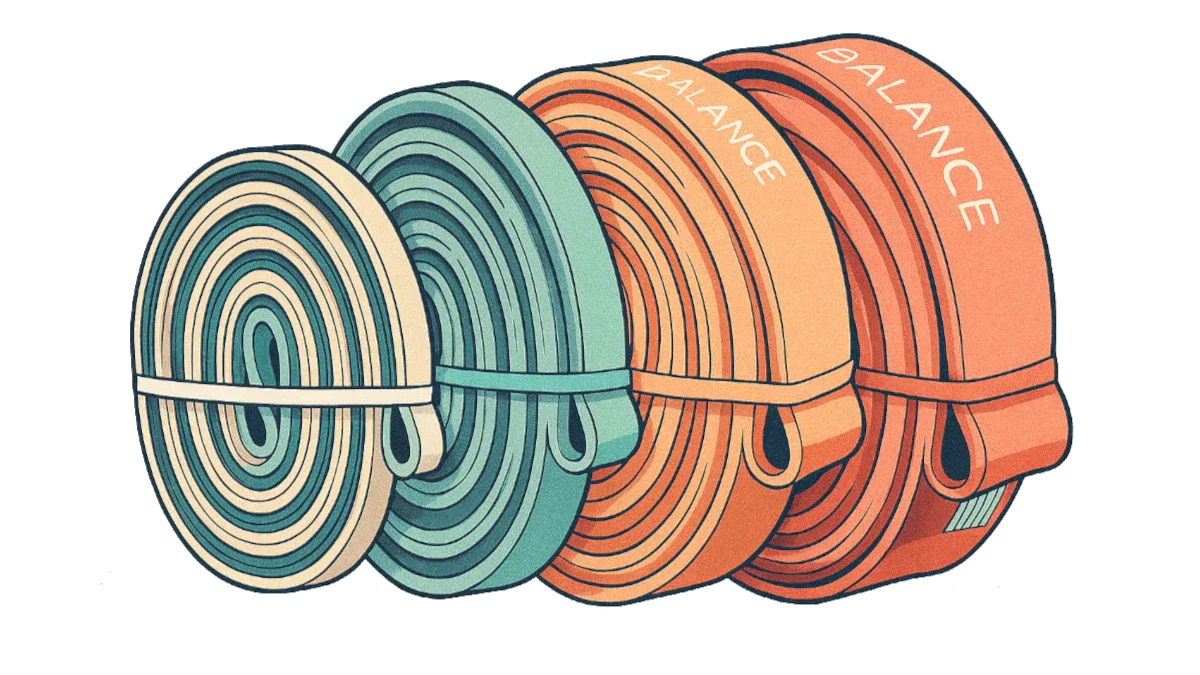
WHY YOU NEED TO USE RESISTANCE BANDS
You can use them at home, while traveling, or in a park. Easy to carry and use, resistance bands have greatly increased in popularity in recent years.
Their practicality appealed to many people, especially during the Covid period, when they allowed for effective training at home.
Thanks to their elasticity , they offer a functional workout for the body and a different approach from traditional weights.
ORIGINS
Resistance bands were invented by two American physiotherapists in the 1970s.
At that time, they were looking for a way to strengthen their patients' muscles without resorting to heavy loads and avoiding trauma to the joints.
The idea was therefore to use a rubber membrane to create a therapeutic training tool. The two practitioners then presented their concept to Hygenic Corporation , a company specializing in medical rubber.
It was this collaboration that enabled the creation of the first TheraBand resistance band.

These bands allowed the tension to be adjusted according to the strength of the patient, improved mobility and stability, and progress to be controlled thanks to a color code indicating different levels of resistance.
The concept quickly gained traction in the world of physiotherapy, considered a significant advancement compared to dumbbells which were too strenuous for weakened muscles.
INTEREST & FUNCTIONING
Variable load
As a reminder, a free weight imposes a fixed and constant load, regardless of the position or amplitude of your movement.
An elastic band, on the other hand, exerts tension proportional to its stretch: the more you stretch it, the greater the restoring force. That's where its usefulness lies!

This means that elastic bands produce an upward load curve : resistance is low at the beginning of the movement (band not very taut) and maximum at the end of the movement (band stretched to the maximum).
This "variable load" aspect translates into a muscular effort that increases throughout the range of motion.
Gravity
Beyond the difference in load profile, resistance bands are not subject to gravity .
The direction of movement is therefore much freer: you can pull a strip towards yourself, at an angle, make a circular movement, etc.
For example, you can simulate a rowing stroke or a punch in the air, things that are difficult to do with a dumbbell.
These two characteristics give bands several advantages and use cases that traditional weights do not allow.
ADVANTAGES OF BANDS VS WEIGHT
Duration of the effort
With a free weight, the load is constant. The force is therefore maximal at the weakest mechanical point , then decreases when the movement is "locked".
Example
Maximum effort in the middle of the squat or bench press, minimum when the arms or legs are straight.
With a resistance band, it's the opposite: the resistance increases as you tighten the band. This forces you to exert force throughout the entire movement and eliminates dead zones in the motion.
This feature offers several advantages:
Thanks to the low resistance at the beginning of the movement, the gesture can be accelerated rapidly before mobilizing maximum effort at the end of the range of motion.
This dynamic promotes an explosive contraction , ideal for speed and power sports such as boxing, sprinting or jumping.
The band creates continuous resistance from start to finish, prolonging the time under tension , a major factor in hypertrophy.
Even though the absolute load is lower than with dumbbells, variable resistance uses more muscle fibers as you tighten the band.
In short : the bands activate more fibers, for a longer period of time.
Since the tension is greatest at the end, you specifically strengthen the muscles involved in stabilizing and closing the movement.
Examples : triceps in a press, glutes in a squat.
Progressive tension avoids peak loads at the beginning of movement, therefore less stress on tendons and joints.
Brain-muscle connection
The muscle-brain connection corresponds to the ability of the nervous system to selectively and efficiently activate the motor units necessary for the movement performed.
Simply put, it's your ability to become aware of the different fibers and tissues to use in order to activate them and perform your movement as efficiently as possible .
Resistance bands strongly stimulate these neural mechanisms for several reasons:
Because the resistance changes with every centimeter of movement, your nervous system must continuously recalibrate which fibers to use.
This effect is even more pronounced when you perform your movement slowly.
The bands provide unstable and directional resistance. This forces you to focus on your stabilizing muscles and tendons to maintain the correct trajectory, thus enhancing proprioception .
Since you don't have a heavy load, there is less joint stress and you can easily focus on the quality of the contraction and the precision of the movement.
This is why bands are very useful for learning a new exercise or for rehabilitation.
DISADVANTAGES OF BANDS VS WEIGHTS
Load limitation
For athletes with very high levels of strength, the bands could show their limitations.
Loading with 200-300 kg equivalent in band is impractical : it would require extremely rigid elastic bands or putting 5 in parallel, which complicates the setup and increases the risk of breakage .

Furthermore, lifting a heavy weight forces the entire body to stabilize against gravity , forcing maximum core engagement and overall activation.
Even a thick band requires a slightly different approach to balance: it guides you towards its attachment point and, as the load is lower at the bottom, the effort required to maintain balance is almost nonexistent at the beginning of the movement.
Elasticity sometimes inadequate
The elastic nature of resistance bands can sometimes prove counterproductive depending on the exercise and the objective.
Let's take squatting as an example:
- If your goal is to strengthen your quadriceps , using a weighted bar may be more relevant, because during the upward movement you will engage these muscles from the start of the movement.
- However, if your goal is to enhance your explosiveness or glutes , then bands may be a better alternative due to the progressive nature of the load.
Difficulty in quantification
Even though the bands are associated with color codes meant to represent a load in kilograms, it remains difficult to precisely quantify their resistance. This is especially true since it varies according to the amplitude.
Lifting a band with "20 kg of resistance" feels very different than lifting a 20 kg dumbbell.
APPLICATIONS & USES
You now understand the strengths and weaknesses of elastic bands, but you're probably wondering how to use them and exploit their full potential.
Gain strength
Bands alone do not provide any real advantages when you are looking to gain strength.
However, when combined with free weights, they allow you to benefit from both the gravitational force of traditional weights AND the upward resistance they provide. This is known as variable resistance training .

The idea is to add elastic tension to a basic movement (squat, bench press, etc.) in order to change the load during the movement and to emphasize the work on the final part (locking).
In general, elastic tension represents 15 to 30% of the total load at the end of the amplitude.
Another approach is to use the bands not to add resistance but to add assistance .
If you are stuck on a weight that you cannot complete, adding bands can help you overcome this plateau by making the movement more accessible .
It's a bit like when someone assists you at the gym to help you do one or two more rehearsals.
Increase explosiveness
The nature of the elastic bands encourages strong acceleration at the beginning of the push (light resistance) while providing progressive resistance that slows the movement little by little.
This aspect is ideal for working on explosiveness because it allows you to produce an explosive movement without any weight flying away due to its inertia, while benefiting from an upward load that forces adaptation .
With a dumbbell, you would be forced to slow down before the end of the movement to avoid injury or to significantly reduce the load.
⚠️ However, be careful not to overload the bands: if the band provides too much resistance, it may restrict your movement and greatly reduce your execution speed.
Developing hypertrophy
As mentioned above, one of the major advantages of bands is to increase the time under tension of the movement being worked on.
By maintaining constant tension, repeating sets close to failure and with short rest periods, they provide a comprehensive approach to developing good muscle volume.
In addition, the bands allow you to work from different angles that can be difficult to reproduce with the gravity of the weights.
For example, for the pectorals, you can attach a band to a low point behind you and make diagonal punching movements.
Using pulleys allows for similar results, but the advantage of elastic bands is that they are less traumatic for your joints than a cast iron weight.
This allows you to add training volume without putting too much stress on your tendons.
Improve mobility and flexibility
Resistance bands are very useful for joint mobility exercises, flexibility training, and improving range of motion.
Their elasticity allows them to provide gradual assistance that helps you reach deeper stretching positions, or conversely, light resistance that strengthens your muscle in stretched positions.

For example, to stretch the hamstrings while lying down (by raising the leg), you can use a band like a strap around the foot: this allows you to pull the leg with your arms and stretch the muscle more deeply.
The difference with a strap is that the elasticity of the rubber helps the muscle to relax and allows for a more gradual stretch.
As for mobility , you can include the bands in more dynamic exercises to increase the range of motion or to warm up and activate your muscles.
For example, lateral steps with a mini band around the knees to activate your hips or trunk rotations with a band fixed to the side to wake up your obliques and strengthen their range of motion.
Rehabilitate / prevent injuries
Functional rehabilitation is the birthplace of elastic bands.
A key advantage of bands for rehabilitation is the progressive nature of the load: you can start with almost no resistance (very flexible bands, low stretch) and then gradually increase, which reduces the risk of relapse .
The approach used is often a format with many repetitions (15-30) and a high frequency (almost daily for small exercises), because the intensity is low and the goal is motor relearning as much as strengthening.
WHICH BANDS TO CHOOSE?
There are several types of tape that serve more or less the same purpose and use. However, using a certain type of tape in a specific context may prove more appropriate.
Furthermore, resistance bands frequently break during exercise, which is why it is recommended to choose high-quality resistance bands that last!
Flat strips
These are the classic bands that you can find in all sports shops.
They are closed loops and are particularly useful for assisting strength exercises such as pull-ups or dips, or for facilitating stretching. Their flat shape allows them to stay securely in place and promotes stability during movement.
Recommendations
Flat Resistance Bands - Smartworkout

Flat Resistance Bands - Gornation
Resistance tubes
These are cylindrical resistance bands, somewhat less well-known than the flat models.
They are open and allow accessories such as handles, bars or other types of attachments to be attached using carabiners, making them particularly useful for strength and explosiveness exercises.
Their advantage is that the elastic is stronger and allows working with higher loads.
Recommendations
Tubular Resistance Band Unit - Smartworkout

Tubular Resistance Band Packs with Accessories - Smartworkout

Mini bands - Booty bands
These are short, wide resistance bands, usually made of elastic fabric.
They are closed and designed to be placed around the thighs, knees or ankles, particularly effective for working the glutes (hence the name "booty band"), improving hip mobility and strengthening the legs in general.
Recommendations
Booty bands / Gluteal bands - Smartworkout

FAQ
Between 3 and 5 sessions per week depending on your level and goals. Resistance bands cause less muscle micro-trauma than weights, so recovery is faster.
You can incorporate them in the form of full-body circuits, targeted exercises, or daily mobility work.
Applications and uses
Yes, they promote fat loss by allowing regular, accessible, and moderate-intensity training.
This type of effort stimulates the aerobic system, thus burning fat, while strengthening lean muscle mass.
Yes, and that's their main focus in terms of performance.
Studies show a marked improvement in the speed at which force is produced, the rapidity of muscle contraction, and the maximum power developed after 6 to 8 weeks of training combining elastic bands and free weights .
Advantages of resistance bands
Free weights provide a constant load based on gravity.
The bands, on the other hand, create an upward resistance : the more you tighten them, the more the load increases.
This corresponds better to the natural strength profile of the muscle, which is stronger at the end of its range of motion.
Because the difference in quality is enormous .
Cheap bands are often made of recycled rubber, which is less elastic, more rigid, and more likely to break.
A premium band maintains constant tension, does not dry out, and guarantees precise and safe muscle work.
Yes. With bands, you can reproduce almost all weight training movements: squats, pull-ups, presses, curls, extensions, etc.
The important thing is the progression of tension: the more you stretch the band or choose a high resistance, the more the effort increases.